The Mission
After making significant investments in maintenance to improve Overall Equipment Effectiveness (OEE), a leading food manufacturer wanted to understand whether its current level of maintenance spending was truly necessary to sustain performance – or whether it exceeded competitive benchmarks.
The objective was twofold:
- Assess the current maintenance organization and compare it against relevant industry benchmarks
- Develop a practical roadmap for maintenance cost optimization
Our Approach
Rather than focusing only on maintenance spend, we assessed the maintenance function as a whole. Using Avencore’s PRIME* model, we benchmarked the client’s maintenance organization across five levels, from operational fundamentals to business impact.
*PRIME = Performance & Reliability Integrated Maintenance Excellence
1 | Benchmarking the Existing Maintenance Organization
We first conducted a comprehensive assessment of the client’s maintenance organization using the Avencore PRIME model.
The model provides a structured, five-level benchmarking approach to evaluate maintenance performance from basic enablers to operational and financial impact:
- Level 1: Basics
Data quality, workforce capabilities, and spare parts management - Level 2: Resources & Costs
Cost structure, resource allocation, and efficiency - Level 3: Planning & Execution
Workload management, preventive maintenance, and execution discipline - Level 4: Reliability & Throughput
Equipment availability, failure patterns, and response times - Level 5: Business Benefits
Operational performance and financial impact
This approach made it possible to identify where the organization was aligned with industry benchmarks and where relevant gaps existed.
2 | Identifying and Prioritizing Improvement Levers
The assessment results were then reviewed together with the client team to identify concrete areas for improvement.
Rather than turning every gap into an action item, we evaluated each potential improvement according to:
- Expected business impact
- Required implementation effort
- Relevance for the overall maintenance organization
This allowed the team to distinguish between structural issues and isolated findings and to focus on the most relevant optimization levers.
3 | Translating the Findings into an Optimization Roadmap
Based on the findings, we developed a maintenance optimization roadmap.
The roadmap translated the benchmark results into a practical sequence of initiatives, balancing quick wins with longer-term improvements.
This created a clear path forward for the client, allowing the organization to improve maintenance performance in a targeted and manageable way rather than through isolated cost reduction measures.
The Result
The project gave the client a transparent view of how its maintenance organization compared to industry benchmarks.
The assessment identified significant maintenance cost optimization potential across all five PRIME levels and translated these findings into a concrete roadmap for implementation.
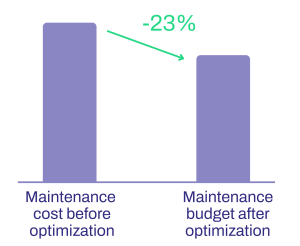
Overall, the identified initiatives represented potential equivalent to a 23% reduction in the maintenance budget.