The Mission
Rising U.S. tariffs were forcing our client to reassess its existing sourcing structure and evaluate whether sourcing relocation to the U.S. would create a real advantage.
To make an informed decision, two questions had to be answered:
- Which HPDC suppliers in the U.S. could realistically serve as an alternative to the current supplier base?
- Would relocating sourcing to the U.S. actually make economic sense?
At first glance, reshoring appeared to be a logical response to increasing tariff pressure. In practice, however, the economics of a sourcing relocation depend heavily on the structure of costs, the availability of suitable suppliers and the specific sourcing region involved.
The objective was therefore to create transparency across both the supplier landscape and the underlying economics in order to determine which relocation scenarios were truly rational and justified.
The Approach
To create a robust basis for decision-making, we combined two complementary workstreams: supplier screening and economic assessment.
1 | Supplier Screening and Evaluation
The first step was to build a transparent view of the U.S. HPDC supplier landscape.
We began with an AI-supported long-listing approach to identify relevant companies across a very broad market. This initial screening covered nearly 900 potential suppliers.
From there, we applied a rule-based shortlisting process to identify the most promising candidates. Suppliers were not evaluated solely on price or production capabilities. Instead, the assessment combined several operational and strategic criteria, including:
- Revenue fit
- Distance to the customer
- Relevant industry experience
- Supply chain resilience
- Overall suitability for the required product portfolio
This process produced a prioritized view of which companies could realistically support a sourcing relocation under the client’s specific requirements.
2 | Economic Assessment of Relocation
Identifying suitable suppliers alone was not sufficient. The second step was therefore to determine the actual economic impact of relocating production to the U.S.
To do so, we analyzed a set of reference products and compared the production costs of the client’s current suppliers with the expected production costs of potential U.S.-based suppliers.
Crucially, the assessment did not focus on tariffs in isolation. Instead, we evaluated the full cost structure behind each sourcing scenario, including factors like labor, material and energy costs.
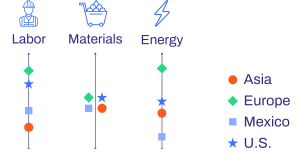
This made it possible to understand where the U.S. would be structurally advantaged and where relocation would lead to higher overall costs despite increasing tariffs.
The Result
The analysis revealed that relocating sourcing to the U.S. does not create the same economic outcome for every region.
The impact varied significantly depending on the current supplier base:
- Relocating sourcing from Asia to the U.S. would result in higher net costs
- Relocating sourcing from Europe to the U.S. would result in lower net costs
- Relocating sourcing from Mexico to the U.S. would lead to broadly similar net costs
The reason lies in the different cost structures of each region. While Asian suppliers benefit from lower labor costs, European suppliers are often disadvantaged by higher labor and energy costs. Mexico, by contrast, already offers a cost structure relatively close to the U.S.
The project therefore demonstrated that reshoring decisions cannot be made on the basis of tariffs alone. A sourcing relocation that appears attractive at first glance may ultimately increase total cost.
The Secret
The key success factor of the project was not the supplier search alone, nor the cost assessment in isolation.
Looking at only one side of the problem would not have been sufficient. Evaluating suppliers without understanding the economic impact of relocation would have created an incomplete picture. Equally, modeling the effect of tariffs alone would not have shown which suppliers could realistically support a sourcing relocation.
The real value came from combining both perspectives:
- Identifying which U.S. suppliers were realistic alternatives to the current supplier base
- Quantifying the economic impact of relocating sourcing from each region to the U.S.
- Prioritizing only those relocation scenarios that were both operationally feasible and financially justified
By linking supplier transparency with a detailed economic assessment, the client was able to make informed and rational sourcing decisions.