Global trade has entered a new era of uncertainty and continuous volatility. In this article, we examine how global tariffs, industrial trade conflicts, and shifting supply chains are challenging manufacturers and industrial companies worldwide. Amid rising trade tensions, quick fixes are no longer sufficient. Industrial companies need a long-term framework to build resilience and stay competitive.
At the end of this article, you’ll find a brief self-check to help evaluate your organization’s current readiness and highlight areas for improvement.
A Rising Challenge: Intensified Trade Disruptions
Over the last few decades, globalization has defined the rules of production and supply. Open markets, predictable trade relations, and global sourcing strategies allowed industrial companies to optimize costs and scale with confidence. But these rules are being rewritten rapidly.
Political decision-making has become more deal-driven, with trade policy being used increasingly to shift global balances. The result: growing uncertainty in industry around tariffs and the free movement of goods.
Tariffs, once considered temporary disturbances or negotiation tools, have become permanent stress tests for industrial players. What was once an exception is now the new normal, with no indication this trend will reverse soon. As geopolitical tensions rise and protectionist policies resurface across major economies, companies must ask: Are we structurally prepared for this new reality, or merely reacting to it?
Many companies still operate on outdated assumptions about trade stability. In a world where volatility is constant, this leaves them dangerously exposed. Recognizing change alone is not enough; navigating it with clarity, adaptability, and foresight separates resilient companies from vulnerable ones.
In such a dynamic environment, traditional tools and responses are no longer sufficient. Building resilience today means thinking beyond the usual levers and designing organizations structurally equipped to withstand and even benefit from disruption.
Industrial Tariffs Are Reaching Historic High
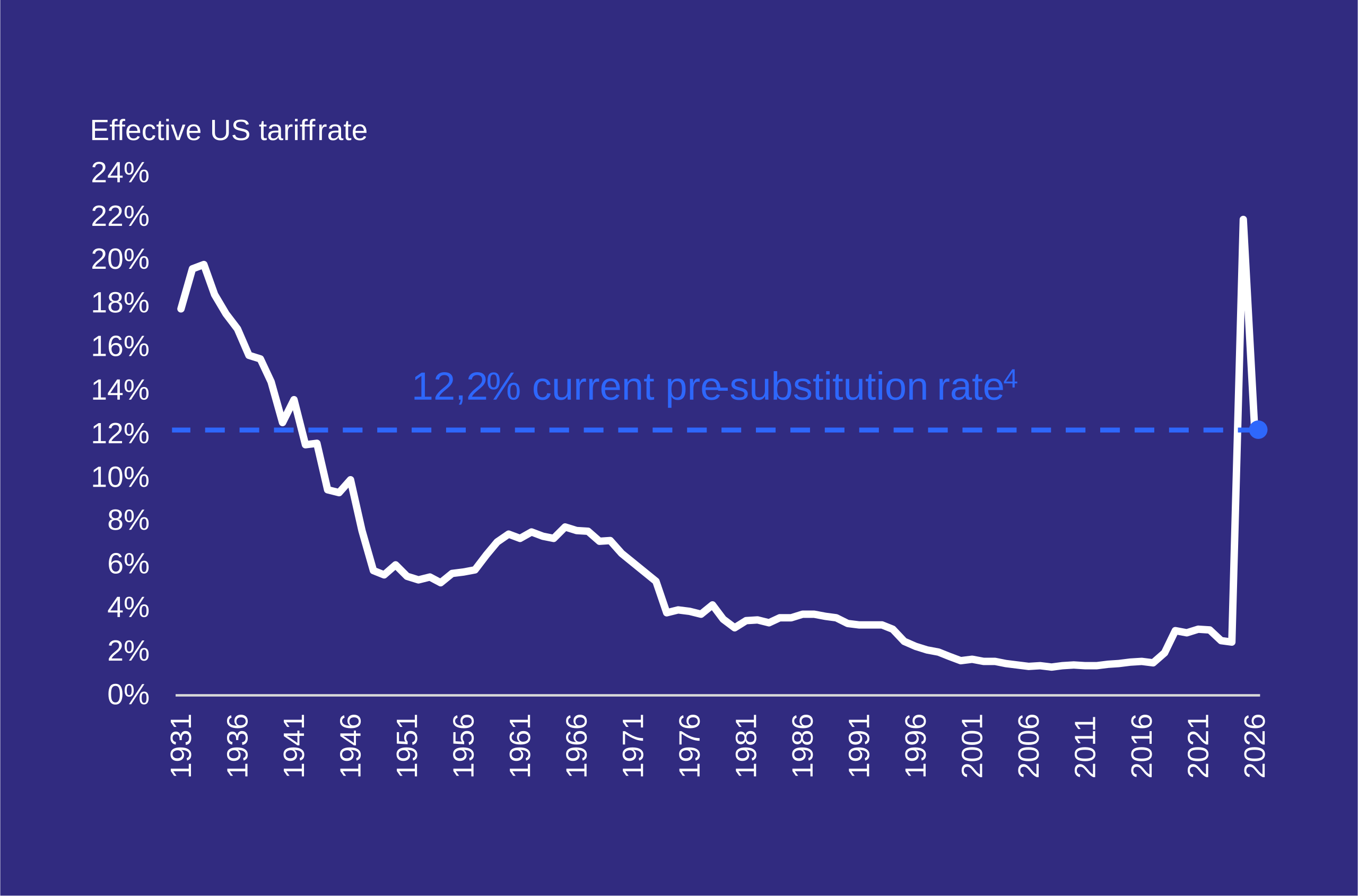
To understand the urgency of the situation, one must look at the numbers. In May 2025, the average U.S. tariff rate soared up to 21.87%. This marks the highest level in over a century, more than ten times higher than in 2024, when the rate was 2.42% 1. Throughout 2025, the average U.S. tariff rate fluctuated between around 15% and 19% 2.
While the rate stood at 16.0% in early 2026, a Supreme Court ruling on February 20th briefly struck down these measures before the administration pivoted to new « Section 122 » surcharges. Currently, a 10% surcharge is in effect, raising the average effective rate to 12.2%. An announced increase to 15% is expected to raise the rate to 13.7% 3, 4.
For many industrial companies, this dramatic jump did more than put pressure on their margins, it challenged the very foundation of their business models. Contracts were signed and pricing calculated under previous conditions. Tariffs now apply on top of these agreements. Companies face difficult choices: absorb the cost and take a loss, or walk away from the deal and forgo the revenue. Neither option is sustainable.
But it doesn’t stop there. The political climate remains unpredictable, and trade agreements that once appeared stable are now fragile at best. This became apparent when the U.S. president raised tariff threats against European countries amid geopolitical discussions about Greenland. This example demonstrates how easily trade policy can become entangled in conflicts far removed from traditional trade considerations.
What we’re witnessing is not an anomaly. It’s a structural shift that requires a structural response.
Which Industries Face the Greatest Exposure?
Not all sectors face the same level of exposure. For some industries the additional tariffs represent more than just higher costs, it threatens their fundamental competitiveness.
Among the hardest-hit sectors are:
- Metals and raw materials 4: These products often form the base of broader supply chains, making tariff increases here especially painful.
- Electrical equipment and machinery 4: Complex cross-border value chains make them highly sensitive to even small trade disruptions.
- Motor vehicles and parts 4: Global production networks and high import reliance make this sector particularly vulnerable to sudden cost increases.
European industrial companies are facing compounded risks. Their export strengths overlap significantly with the product categories now subject to U.S. tariffs. This means that the impact is not only deep but also broad, spanning across core industries that form the backbone of many national economies.
Moreover, some companies assumed that shifting production closer to their end markets would provide insulation. But recent trends show that even geographic proximity is no longer a reliable shield. Tariffs are being applied in ways that defy traditional logic by targeting strategic sectors rather than trading blocs.
Operating Under Constant Trade Uncertainty
These days, trade uncertainty has become the new normal for industrial companies. There is no stable reference to plan against, nor any predictable sequence from policy announcement to implementation. Rules can change overnight, take effect immediately, and be reversed just as quickly through political deals.
Product groups affected, tariff levels, and lead times can shift without warning. Decisions made under one set of rules may be invalid the next day. In some cases, tariff changes apply immediately, even to goods already in transit, leaving companies exposed without any time to adjust.
For companies, the challenge is not to eliminate uncertainty, but to remain capable of operating across both extremes. They must sustain stability where possible while preparing to absorb and respond to sudden disruptions when conditions shift.
Why Industrial Players Need Strategic, Not Just Tactical Responses
Many companies are reacting tactically – passing tariff costs to customers, reshuffling Supply Chains, or shifting toward local production. While these responses may buy time, they often come at the cost of added complexity, reduced scale efficiencies, and new vulnerabilities.
- Price Adjustments: 54% of companies pass tariff-related costs on to customers – at least partially – without fully understanding the underlying margin risks 5.
- Supply Chain Modeling: 68% engage in rapid supplier diversification or relocation, but without a clear resilience strategy, this can raise costs and introduce instability 6.
- Localization: Regionalization may reduce exposure, but it can also limit innovation and increase dependency on domestic risks.
Short-term fixes are not enough. Real competitive advantage lies in building systemic resilience.
Building Long Term Resilience in Industry
Resilience is not built overnight. It is the result of deliberate planning, cross-functional coordination, and long-term commitment. At Avencore, we recommend a structured, three-phase approach:
- Achieve full cost transparency under new tariff regimes
- Secure short-term supply continuity
- Install an operating model for product compliance to shift from reactive firefighting to proactive steering wherever possible
- Rebalance Supply Chain footprints to diversify exposure
- Increase agility in procurement and production planning
- Decouple critical dependencies on single markets or suppliers
- Build strategic resilience into organizational design
- Develop internal governance models for continuous cost-performance control
- Turn trade volatility into a source of competitive advantage
Each phase builds on the previous one. It’s a journey – from reaction to adaptation and ultimately to transformation.
Where Does Your Company Stand?
Before making the next move, industrial leaders should reflect:
- Do we have full visibility on tariff exposure across our value streams?
- Are current Supply Chain adjustments tactical fixes or part of a broader strategic redesign?
- Have we modeled multiple trade scenarios with clear action plans?
- Are we treating trade volatility solely as a risk, or also as an opportunity?
If any answer is unclear, now is the time to act, to build resilience, sharpen strategy, and stay ahead in a shifting global landscape.
Avencore as Your Partner
As transformation experts, we at Avencore help industrial firms move beyond short-term firefighting. Our end-to-end methodology covers every stage of the resilience journey. A few of our proven methods are:
- Regulatory compliance operating model design
- Rapid tariff impact diagnosis
- Supplier risk and exposure mapping
- Value stream transparency and scenario simulations
- Targeted make-or-buy decisions and network redesign
- S&OP optimization and cost governance framework.
We don’t believe in one-size-fits-all solutions. Instead, we co-develop strategies that are tailored to your organization, industry, and competitive context. Whether you’re at the beginning of this journey or already deep into it, our team brings the experience and tools to help you go further, faster.
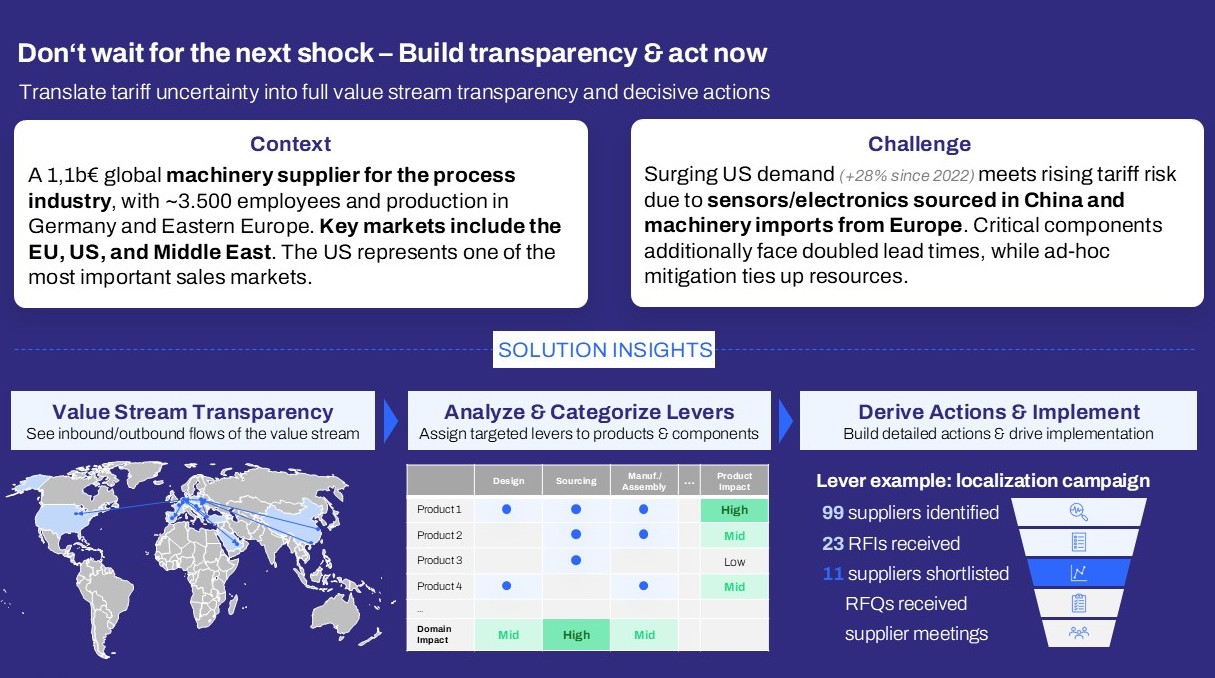
In a world defined by disruption, waiting may be the riskiest strategy of all. The industrial companies that emerge strongest will be those who treat volatility not as a threat, but as an opportunity to build smarter structures, tighter cost control, and long-term resilience.
Contact Avencore today to start building a strategy that turns global trade disruption into a competitive.
Sources:
1 The Budget Lab at Yale. State of U.S. Tariffs: May 23, 2025. May 23, 2025. https://budgetlab.yale.edu/research/state-us-tariffs-may-23-2025
2 The Budget Lab at Yale. State of U.S. Tariffs: November 17, 2025. November 17, 2025. https://budgetlab.yale.edu/research/state-us-tariffs-november-17-2025
3 The Budget Lab at Yale. State of U.S. Tariffs: SCOTUS Ruling Update. February 20, 2026. https://budgetlab.yale.edu/research/state-us-tariffs-scotus-ruling-update
4 The Budget Lab at Yale. State of U.S. Tariffs: February 21, 2026. February 21, 2026. https://budgetlab.yale.edu/research/state-tariffs-february-21-2026
5 Allianz Trade Global Survey 2025: Trade war, trade deals and their impacts on companies. Allianz Research, 20 Mai 2025. https://www.allianz-trade.com/content/dam/onemarketing/aztrade/allianz-trade_com/en_gl/media/news/2025-05-20-Trade-survey-AZT.pdf
6 RELEX Solutions. State of Supply Chain 2025: Supply Chain Resilience in an Era of Volatility. 2025. https://hub.relexsolutions.com/state-of-supply-chain-2025